CBD vs THC: What Is the Difference?
THC is the compound that makes you feel high. CBD is not intoxicating. Here is how the two differ, how to read the ratios on a dispensary menu, and why hemp CBD and dispensary CBD are not the same shelf.
Updated August 13, 2026 7 min read
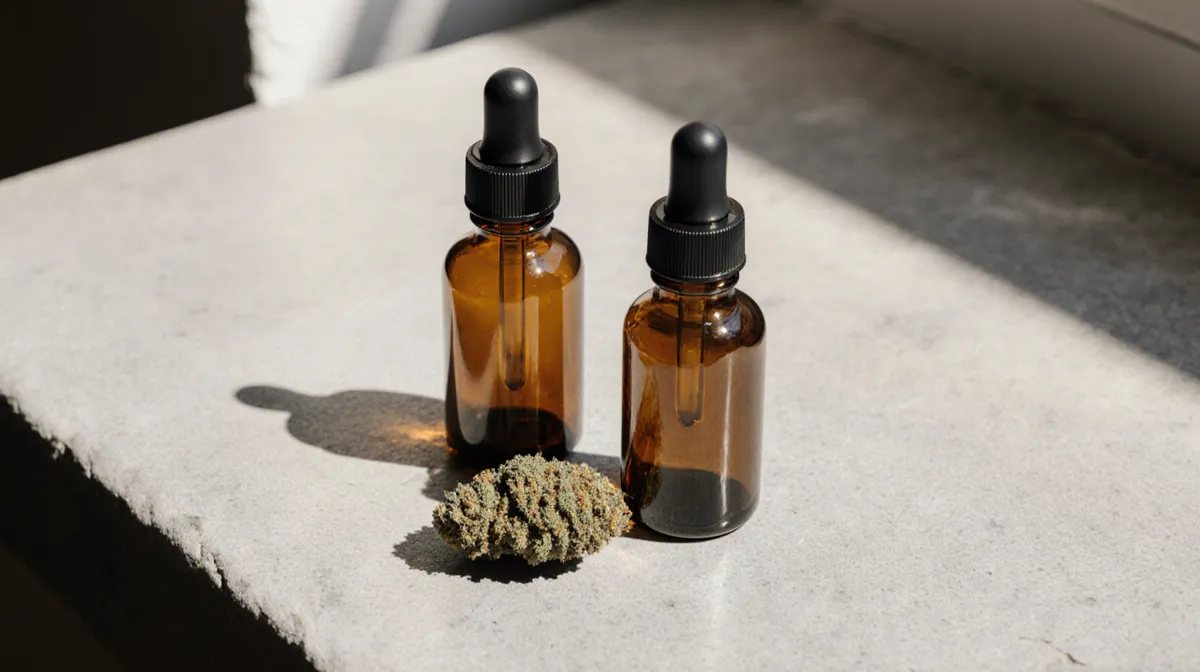
Two compounds from the same plant
CBD and THC are the two cannabinoids you will see named most often on a dispensary menu, and they come from the same plant. Cannabis produces more than a hundred cannabinoids, but these two dominate the labeling because they are usually present in the largest amounts and because they behave so differently from one another.
The short version, the one worth carrying into a shop with you: THC is the compound responsible for the intoxicating effect people describe as being high. CBD is not intoxicating. A product high in CBD and low in THC will not produce that effect no matter how much of it is in the package.
Everything else is detail, but the detail is what determines whether the thing you buy matches what you were picturing. Menus rarely explain any of it, and the numbers printed on a package assume you already know how to read them.
Both compounds begin life in the plant as acids. What eventually becomes THC starts as THCA, and what becomes CBD starts as CBDA. Neither acid form is intoxicating on its own. Heat converts them, which is why raw flower does nothing until it is smoked, vaporized or baked into something. If that conversion step is new to you, our explainer on THCA covers why raw flower tests at high numbers and still does nothing straight from the jar.
What THC does
THC is the compound most people mean when they talk about cannabis effects. It binds readily to receptors concentrated in the brain and central nervous system, and that binding is what produces the shift in perception, mood, appetite and sense of time that users commonly report.
Those reports vary enormously between people, and they vary within the same person depending on the amount taken, the format, tolerance, and what else is going on that day. Two people can consume the same product and describe two different experiences. That variation is normal and it is one reason cannabis is difficult to generalize about.
THC is also the compound driving the number most shoppers fixate on: the percentage on the front of the package. That percentage is worth understanding rather than chasing, since it tells you about potency by weight and not much about what the experience will be like. We wrote about that gap in detail in our guide to THC percentage.
Some people find higher THC amounts uncomfortable, reporting anxiety or a racing heart. If that describes a past experience, that is useful information to bring to a budtender rather than something to push through.
What CBD does
CBD interacts with the body's endocannabinoid system too, but it does not bind to the same receptors in the same way THC does, and it does not produce intoxication. People who use CBD products generally describe them as subtle rather than dramatic. Some report a sense of calm or physical ease; others report noticing very little at all. Both of those outcomes are common and neither is unusual.
It is worth being blunt about the limits of what anyone can tell you here. CBD is the subject of a large and still unsettled body of research. Marketing around it has consistently run ahead of the evidence, and you will encounter claims in shops, on packaging and online that are not supported by anything rigorous. Weedtip does not make claims about what CBD does or does not do for any health condition, and you should treat confident claims from anyone selling it with the same caution you would apply to any other product marketing.
If you are considering cannabis in relation to a medical situation, that is a conversation for a clinician who knows your history, not for a product listing.
Reading ratios on a menu
Once you understand that the two compounds behave differently, the ratios on dispensary menus start to make sense. You will see products described as 1:1, or 20:1, or 5:1. The convention is CBD listed first, THC second, though it is not universal and it is always worth confirming which way round a specific brand writes it.
A 1:1 product contains roughly equal amounts of each. A 20:1 product contains twenty times as much CBD as THC, which usually means the THC content is low enough that most people do not report much intoxication, though "usually" is doing real work in that sentence and formats differ. A product listed as 0:1 or simply as THC only contains essentially no CBD.
You will also see three terms used to describe how much of the rest of the plant made it into the final product:
- Full spectrum means the extract retains the other cannabinoids and terpenes present in the source material, including some THC.
- Broad spectrum means most of that profile is retained but the THC has been removed or reduced.
- Isolate means a single purified cannabinoid, usually CBD, with everything else stripped out.
Terpenes are the aromatic compounds that give different cannabis varieties their distinct smell, and they are frequently discussed as contributing to how a product comes across. Our terpene reference breaks down the common ones individually if that is a rabbit hole you want to go down.
Hemp CBD and dispensary CBD are not the same shelf
This is where a lot of confusion originates. CBD products are sold in two very different regulatory contexts.
Hemp-derived CBD is sold widely outside licensed cannabis shops: pharmacies, grocery stores, gas stations, online. Hemp is defined in federal law by a THC threshold, and products made from it are generally allowed to move through ordinary retail channels. The catch is that this category has been inconsistently regulated, and independent testing over the years has repeatedly found products whose contents did not match their labels.
Dispensary CBD comes from the licensed cannabis supply chain in states that have one. Those products are subject to that state's testing, labeling and packaging requirements, which are typically far more demanding. If you want confidence that the number on the package reflects what is in the package, a licensed shop is the stronger bet.
Cannabis law varies substantially by state and it changes. Rules on hemp-derived products in particular have been actively revised in a number of states in recent years, and what is on a shelf in one state may not be on a shelf in the next one. Check the current rules where you are, and never carry cannabis products across state lines regardless of what either state allows.
Weedtip is a directory. We list licensed shops so you can find one and see what they carry; you browse here and buy there.
What to actually look at on the label
Once you know what the two compounds are, the label becomes readable.
Both numbers, not just one. Look for the THC content and the CBD content stated separately, in mg for edibles, tinctures and topicals, or as a percentage for flower and concentrates.
Total contents versus per serving. A tincture bottle and a single dose are different units. Edibles are labeled per piece and per package, and those two numbers can be far apart. Read which one you are looking at.
Test results. Licensed products carry batch testing, often reachable through a code on the package. That is your check on whether the stated contents are real.
The format. How a product is taken changes how quickly effects arrive and how long they last, independently of what is in it. A tincture and an edible containing identical amounts behave differently. Tinctures and topicals covers those formats specifically.
We are not going to tell you how much to take. Nobody writing an article can responsibly do that, because the right amount depends on you. Products are labeled in mg precisely so that the label and a budtender who can see the actual package are the right sources.
Questions worth asking at the counter
Budtenders talk to people about this all day and they will not be surprised by a basic question. A few that get useful answers:
- What is the THC and CBD content of this, and is that per piece or per package?
- Is this full spectrum, broad spectrum or isolate?
- I have found high-THC products uncomfortable before. What would you point me toward?
- Can I see the test results for this batch?
All cannabis purchasing is restricted to adults 21 and over, or to registered patients where a state medical program sets different terms. Bring valid government-issued ID; every licensed shop checks it at the door.
If you are still working out how a first visit goes, what to expect at a dispensary walks through the whole thing from the ID check to the counter.