What Are Terpenes in Weed? A Beginner's Guide
Terpenes are the aroma compounds that give every batch of cannabis its particular smell and much of its character. Here is what the percentages on a label actually mean, the terpenes you will see most often, and how to use them to find more of what you liked.
Updated August 16, 2026
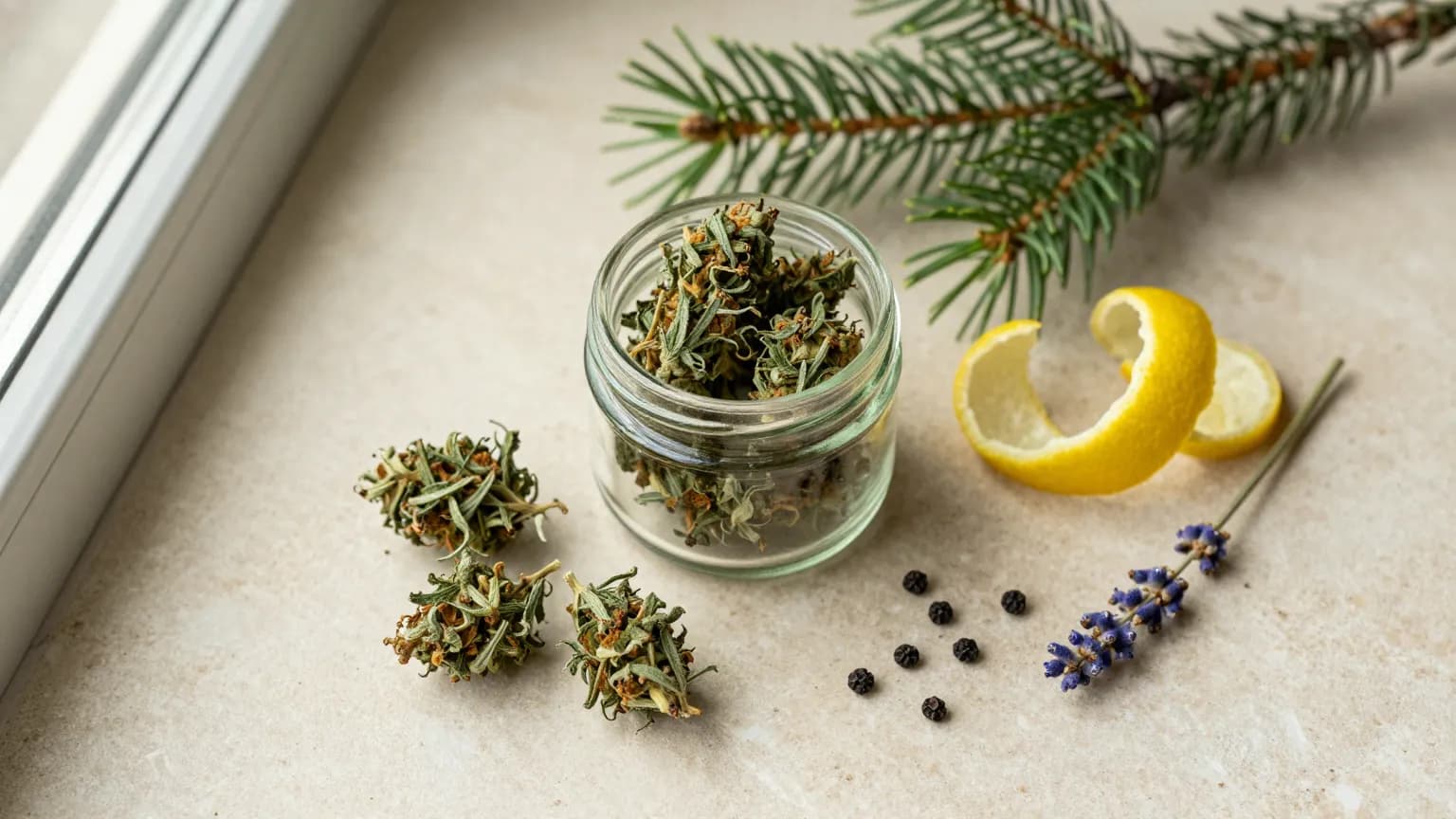
Walk into a licensed shop, ask for something uplifting, and there is a good chance the budtender turns the jar around and points at a line on the label you have never read: a list of terpenes with percentages next to them. Terpenes have quietly become the thing experienced shoppers look at first, sometimes before THC. Here is what they are, what they are not, and how to actually use them when you are standing at the counter.
This guide is written for adults 21 and over, or for patients enrolled in a state medical program where the age rules differ.
What terpenes actually are
Terpenes are aromatic compounds. They are the reason a lemon smells like a lemon, a pine forest smells like a pine forest, and a jar of cannabis smells like whatever it smells like. Plants across the world produce them, and cannabis happens to produce a lot of them, concentrated in the same sticky resin glands that hold cannabinoids like THC and CBD.
A few practical points follow from that.
Terpenes are not cannabinoids. THC and CBD attach to receptors in the body in a fairly specific way. Terpenes are a much broader family of aroma molecules, and on their own, in the amounts present in a jar of flower, they are not what makes cannabis feel intoxicating. If a product is described as "high in limonene" that tells you about the smell and the character of the flower, not about potency.
Terpenes are volatile. They evaporate at relatively low temperatures and they degrade with light, heat, and air. That is why a jar that smelled incredible in the shop can smell like hay two months later, and why the same strain from two different growers can be almost unrecognizable.
Terpenes are measurable. Most state testing regimes require a cannabinoid panel, and many labs offer an optional terpene panel on top of it. When a brand pays for that panel, the results usually end up on the label or on the product page, expressed as a percentage of total weight. A flower product in the range of one to three percent total terpenes is generally considered aromatic. Concentrates like live resin can run considerably higher because the extraction is designed to preserve them.
Why the same strain name can smell completely different
Strain names are not a regulated system. Nobody owns "Blue Dream," and two farms growing plants they both call Blue Dream can end up with meaningfully different chemistry depending on the genetics they started from, how the plants were grown, when they were harvested, and how carefully they were dried and cured.
Terpene results are one of the few pieces of information on a package that describe the actual batch in your hand rather than a name someone applied to it. That is the practical argument for reading them. A name tells you what lineage the grower believes they have. A terpene panel tells you what came out of the room that season.
This is also the honest answer to the endless indica versus sativa argument. Those two words originally described plant structure and growing habit, not effects, and the modern market applies them loosely. Our explainer on indica versus sativa goes deeper, but the short version is that the chemical profile of a specific batch is a more useful signal than the category word on the shelf tag.
The terpenes you will see most often on a label
A handful of terpenes show up again and again in commercial cannabis. Descriptions below are about aroma and about what consumers commonly report, not claims about what any compound does to a body.
Myrcene is the most common terpene in cannabis by a wide margin. It smells earthy and a little fruity, somewhere near ripe mango and damp soil. It is frequently found at the top of the panel in flower that people describe as heavy or relaxing. You can read more on the myrcene page.
Limonene smells like citrus peel, bright and sharp. It is common in cultivars people reach for when they want something they describe as lifted or social.
Caryophyllene is peppery and a bit spicy, the same compound that gives black pepper its bite. It is unusual among terpenes in that it interacts with the body's endocannabinoid system directly, which is why it comes up often in research discussions.
Pinene smells like pine needles and fresh rosemary. It tends to appear in smaller amounts than myrcene or limonene but it is very recognizable when it is there.
Linalool is floral, the lavender note. It is usually a minor component rather than a dominant one.
Terpinolene is harder to pin down, a mix of floral, herbal, and faintly citrus. Cultivars led by terpinolene are relatively rare and people who like them tend to like them a lot.
Humulene is hoppy and woody, which makes sense: it is a major aroma compound in beer hops.
Ocimene is sweet and herbal, sometimes described as mango skin or fresh basil.
You can browse all of these and the products associated with them from the terpenes hub.
Terpenes, THC, and the entourage effect
"Entourage effect" is the phrase for the idea that cannabinoids and terpenes together produce a different experience than any one of them isolated. It is a plausible idea and it is actively researched, but it is worth being straight about the state of the evidence: much of the supporting work is laboratory research or small studies, and it is not settled science. Anyone telling you the entourage effect is proven is ahead of the literature.
What is fair to say is more modest and more useful. Two products with nearly identical THC numbers can feel quite different to the same person, and the aroma profile is one of the few available explanations for that difference. Plenty of regular consumers have concluded from their own experience that chasing the highest THC percentage on the shelf is a poor way to pick a product. Terpene panels give you something else to compare.
Effects also vary enormously between individuals, based on tolerance, setting, what you ate, and how you consumed. Two people can smoke the same joint and describe two different afternoons.
How to shop by terpene instead of by strain name
Here is the version that works at an actual counter.
Start from what you liked before. If a jar worked for you, photograph the label, terpene panel included. Over a few purchases you will notice a pattern, and that pattern is more portable than a strain name because you can hand it to any budtender in any shop.
Smell the product if the shop allows it. Many licensed dispensaries keep sniff jars on the counter for exactly this reason. Your nose is a real instrument here. If a jar smells like nothing, its terpenes have probably faded, and a faded jar rarely impresses regardless of the number printed on it.
Ask whether the terpene panel is available. Not every brand pays for the optional test. If it is not on the package, the shop may still have the certificate of analysis, and a good budtender will know.
Treat the total percentage as a quality signal. Total terpene content correlates loosely with how carefully flower was grown, dried, and cured, which is one of several things worth checking. Our guide on judging flower quality covers the rest of the checklist.
Remember that concentrates and vapes are a different conversation. Some extracts preserve the original terpenes from the plant, some have terpenes reintroduced after extraction, and some use botanical terpenes sourced from other plants entirely. None of that is inherently bad, but the label language differs and it is a reasonable thing to ask about.
Weedtip is a directory. You browse menus and read up here, then you buy at the licensed shop itself. Availability, testing requirements, and what a shop is permitted to print on a label all vary by state and change over time, so treat anything you read online as a starting point rather than the final word for where you live.
Protecting the terpenes you paid for
Since terpenes evaporate, storage matters more than most people assume. Heat, light, and open air are the enemies. A jar left on a sunny windowsill loses aroma fast, and an over dried jar loses it faster still. Glass with a tight seal, kept somewhere cool and dark, buys you months instead of weeks. There is a fuller walkthrough in our guide to storing cannabis.
Temperature at the moment of consumption matters too. Terpenes boil off at lower temperatures than cannabinoids do, which is the reasoning behind lower temperature settings on vaporizers: you get more of the flavor before the harsher combustion notes take over. A flame applied directly to flower burns off a good portion of the aroma profile in the first second.
The short version
Terpenes are the aroma compounds that give each batch of cannabis its particular smell and much of its character. They are measurable, they appear on many labels, and they describe the specific product in front of you rather than a name someone assigned to a lineage. They are not a potency measurement, and no honest guide will tell you a given terpene guarantees a given experience.
Use them the way an experienced shopper does: as a repeatable way to find more of what you already liked, and as a reason to stop treating the biggest THC number on the shelf as the only thing worth reading.