Joint vs Blunt vs Spliff: What Is the Difference?
A joint is cannabis in rolling paper, a blunt is cannabis in a tobacco leaf wrap, and a spliff is cannabis mixed with tobacco. Here is what each one actually contains, how they differ when you smoke them, and what shows up on a dispensary menu.
Updated August 20, 2026
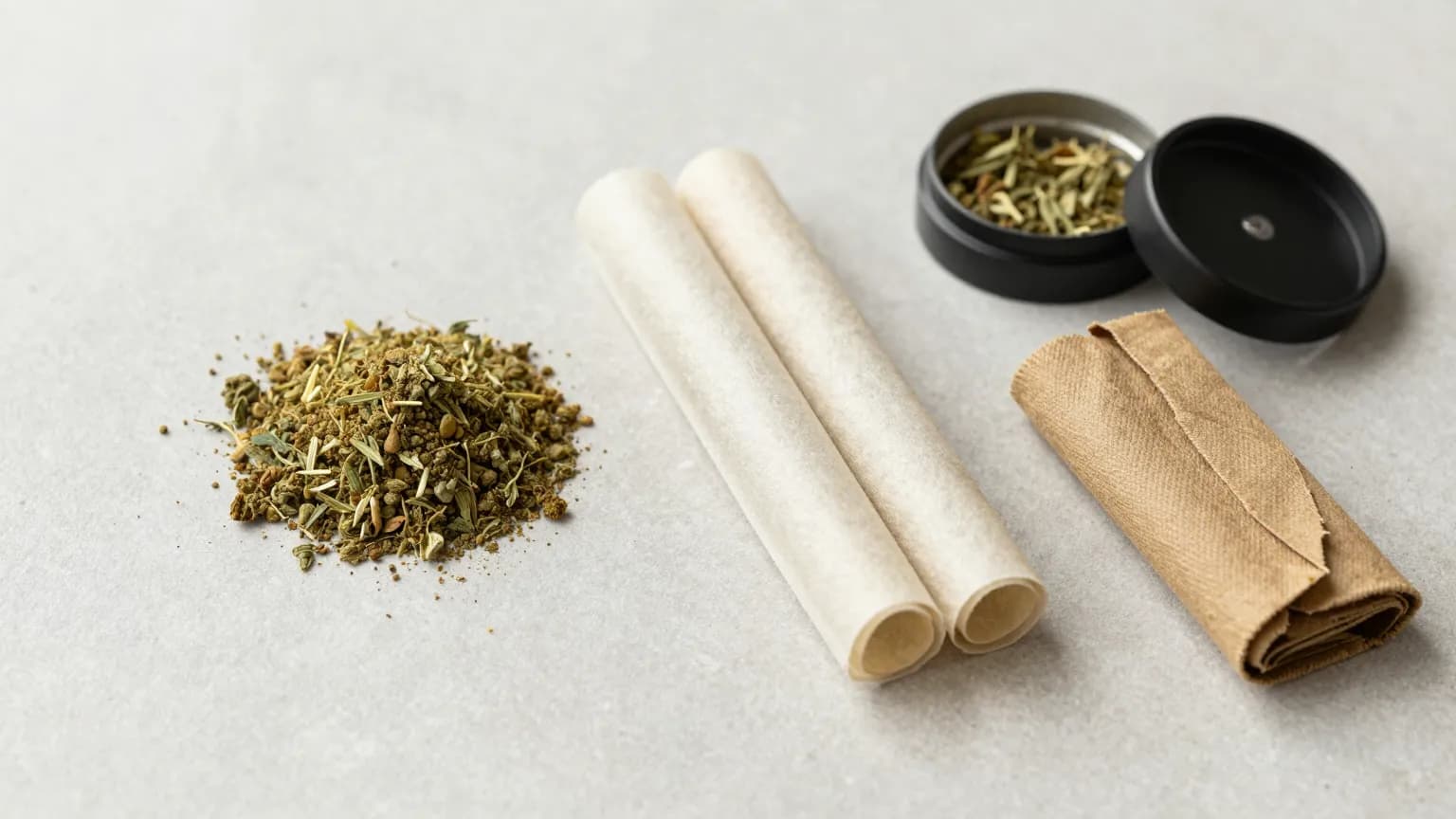
The short answer
All three are rolled cannabis, and the difference is entirely in what does the rolling and what else is inside.
A joint is cannabis flower rolled in thin, unbleached rolling paper. Nothing else in it.
A blunt is cannabis rolled in a tobacco leaf wrap, usually a hollowed out cigar or a purpose made blunt wrap. The wrap itself is tobacco, so a blunt contains nicotine even though the material inside is cannabis.
A spliff is cannabis and loose tobacco mixed together and rolled in ordinary rolling paper. The wrap is not tobacco, but the mix is.
That is the whole distinction. Joint means paper and cannabis. Blunt means a tobacco wrap. Spliff means tobacco blended into the cannabis. Every other difference, size, burn time, flavor, how strong it smells, follows from those three facts.
Worth knowing before you shop: the words get used loosely, and regionally. In much of the UK and Europe, "joint" and "spliff" are used interchangeably and both usually contain tobacco, because mixing tobacco with hash or flower is the default there. In the US, a joint almost never has tobacco in it. If you are reading a forum thread or talking to someone who learned to roll somewhere else, that gap explains a lot of confusion.
The joint
A joint is the plainest version of the format. Ground flower, a rolling paper, and usually a small rolled cardboard tip at the mouth end called a crutch or filter, which keeps the end from collapsing and stops bits of flower from pulling through. It does not filter much of anything, despite the name.
Papers come in a few materials. Thin rice papers burn slowly and add almost no flavor. Hemp papers are slightly thicker and a bit more forgiving to roll. Wood pulp papers are the easiest to handle and the fastest burning. Some people care intensely about this and most people never notice. Sizes run from a single wide paper, which holds well under a gram, up to king size and beyond.
Because there is nothing in a joint but cannabis and a very thin paper, the flavor you get is mostly the flower's own aroma. If you are the sort of shopper who reads terpene percentages on a label and wants to actually taste the difference between a citrus forward batch and a pine forward one, a joint is the format that gets out of the way. A joint lets the flower's own aroma come through with the least interference.
The dispensary version of a joint is a pre-roll, which is simply a joint rolled at the shop or by a brand and sold ready to go. Sizes are usually half a gram or a full gram, sometimes packs of five small ones. If you want the full breakdown on what goes inside them and how to judge one, see what a pre-roll is.
The blunt
A blunt swaps the paper for a tobacco leaf. Historically that meant splitting open an inexpensive cigar, dumping the tobacco filler, and repacking the hollow leaf wrap with cannabis. Purpose made blunt wraps and cones now sell the leaf on its own, without the cigar around it.
Two things follow from that wrap.
First, size. A tobacco leaf is much sturdier than rolling paper, so a blunt holds a lot more. One to two grams is common, and a large one can hold more than that. This is why blunts are traditionally a group format rather than a solo one.
Second, the tobacco. The wrap is a tobacco product, so a blunt delivers nicotine along with the cannabis. That is not a side note. Nicotine is habit forming, and someone who does not use tobacco and does not want to start should know that a blunt is not a tobacco free option no matter what is packed inside it. It also changes the taste noticeably: a blunt has a heavier, sweeter, more roasted flavor that sits on top of whatever the flower tastes like.
Blunts also burn longer and slower than joints, both because there is more material and because the leaf is denser than paper. That is part of the appeal for some people and the reason others find them a commitment.
Hemp wraps exist as a middle path. They are shaped and sized like a blunt wrap but made from hemp rather than tobacco, so you get the size and the slower burn without the nicotine. Many licensed dispensaries that sell blunt style pre-rolls use hemp wraps for exactly this reason, since selling tobacco and cannabis together is restricted or outright prohibited in a lot of markets. Rules vary by state and change, so what a shop is allowed to stock in one place may not be legal in the next one over.
The spliff
A spliff is cannabis and tobacco mixed together, then rolled in regular paper. The wrap is neutral. The blend is the point.
The ratio is up to whoever rolled it, and it varies enormously, from a light pinch of tobacco to something closer to half and half. The practical effect is that a spliff is less cannabis per unit of smoke than a joint of the same size, and it carries nicotine.
Spliffs are common in places where hash rather than flower has historically been the norm. Crumbly hash does not roll well on its own, and tobacco gives it structure and helps it stay lit. That is a big part of why the format took hold in Europe and why the vocabulary drifted there.
In American dispensaries you will basically never see a spliff for sale. Licensed cannabis retailers are not generally in the business of selling tobacco blends, so this is a roll your own format rather than a menu item.
How the three actually differ when you smoke them
Set the definitions aside for a second and compare them the way a shopper would.
Amount of cannabis. A joint is all cannabis. A blunt is all cannabis inside a tobacco wrap, and there is usually more of it. A spliff is cannabis cut with tobacco, so the same size roll contains less flower.
Nicotine. A joint has none. A blunt and a spliff both do. This is the difference that matters most and the one that gets glossed over most often.
Flavor. A joint tastes like the flower. A blunt tastes like the flower plus the wrap, which is a strong, sweet, cigar like character. A spliff tastes like the blend, and tobacco is assertive enough that it tends to lead.
Burn time and size. Roughly, a half gram joint is a short session, a gram joint is a moderate one, and a blunt is a long one. Blunts burn slowest.
Smell. All three are conspicuous. Blunts are the loudest and linger the longest, on your clothes and in a room. Where you can smoke any of them is a separate question with its own rules, and public consumption is restricted almost everywhere cannabis is legal. See where you can legally smoke for how that generally works, keeping in mind that it varies by state and by city.
Practicality. Joints are the easiest to buy ready made, the easiest to share or not share, and the easiest to put out and save. Blunts are the hardest to roll well and the least forgiving if you are not going to finish one.
What you will find on a dispensary menu
If you are shopping rather than rolling, here is how these translate to what is actually on the shelf.
Pre-rolls are joints. They dominate the ready to smoke section, usually in half gram and one gram sizes, sometimes in multipacks of smaller ones. Infused pre-rolls have concentrate added to or coated onto the flower, which makes them considerably stronger than the same size plain pre-roll. The label will say so and the price will too.
Blunt style pre-rolls show up as larger cones, often one to two grams, and the wrap is usually hemp rather than tobacco at a licensed shop. If the wrap material matters to you, ask, because "blunt" on a menu does not tell you which one it is.
Flower by the gram or eighth is what you buy if you intend to roll your own, whatever format you prefer. Rolling papers, wraps, cones and grinders are usually sold at the same counter.
Quality applies across all three formats, and it is easier to judge in loose flower than in something already rolled. If you are buying flower to roll yourself, how to tell if weed is good quality walks through what to look at.
A budtender can tell you what is in a specific pre-roll, whether it is trim or whole flower, and what the wrap is made of. That is a fair question to ask and a normal one. Browse shops near you on Weedtip and buy at the shop itself. Everything here assumes adults 21 and over, or the equivalent under a state medical program, and cannabis laws differ from state to state and keep changing, so treat local rules as the final word.