How Is Weed Grown? From Seed to Dispensary Shelf
Every jar on a dispensary shelf started as a seed or a cutting months earlier. Here is the full path: veg, flower, harvest, drying, curing, lab testing, and what each step tells you when you shop.
Updated September 7, 2026
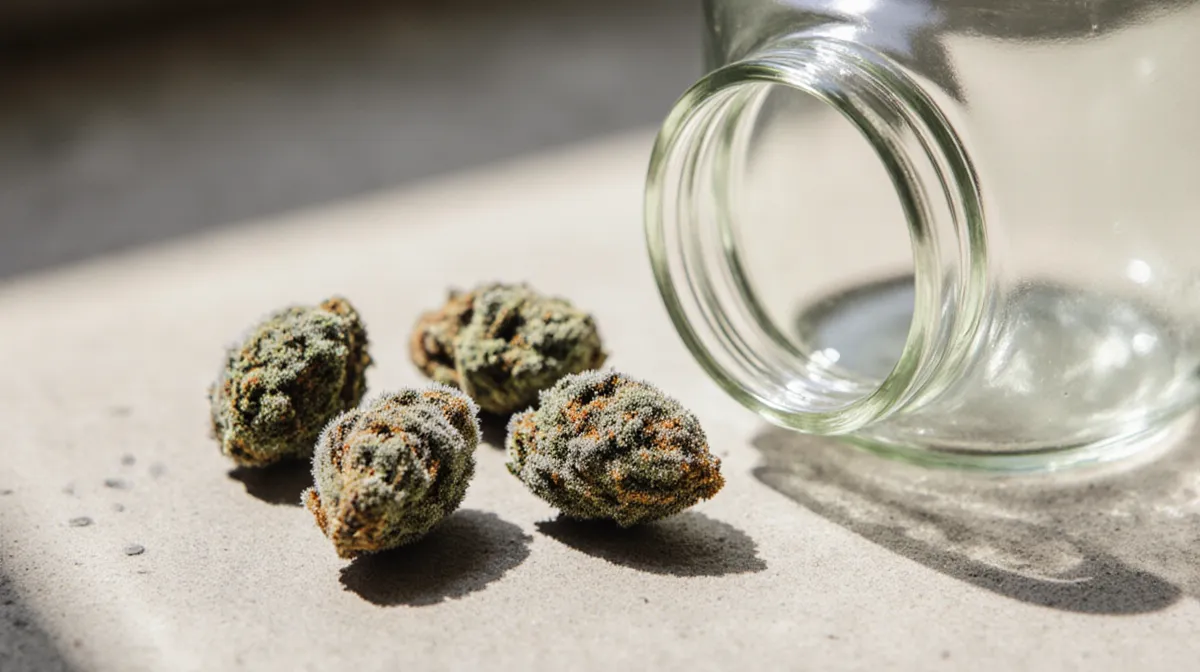
Cannabis on a dispensary shelf looks like a finished product: a sealed jar, a label, a price. Behind it sits three to six months of farming, plus a few weeks of drying, curing, testing and packaging. Knowing roughly how that happens makes the menu easier to read, because most of the words shoppers find confusing are just descriptions of a step in the process.
Here is the whole path, from a seed or a cutting to the jar you pick up at a licensed shop.
Where every plant starts: seeds or clones
Growers begin one of two ways.
Seeds are the slower route and the one used for breeding. Every seed is genetically unique, the way siblings are, so a grower who plants a hundred seeds gets a hundred slightly different plants. Commercial growers usually sprout a batch, watch them, and pick the standout individual. That single plant is called a pheno, short for phenotype, and it becomes the mother.
Clones are cuttings taken from that mother. A small branch is snipped, rooted, and grown into a full plant that is genetically identical to its parent. This is why the same strain name can be consistent from harvest to harvest at a given farm: the grower is not replanting seeds each cycle, they are copying one plant over and over.
It also explains why the same strain name can taste and feel different between two brands. Two farms may be running two different phenos of the same cross, in different rooms, with different feeding. The name on the jar is a family, not a serial number. Our explainer on whether strain names mean anything goes deeper on that.
Vegetative growth: building the frame
Once a clone has roots, it goes into what growers call veg. Under long hours of light, roughly 18 hours a day indoors, the plant does nothing but get bigger: more stems, more leaves, more root mass. No buds yet.
Veg usually runs two to eight weeks depending on how large the grower wants the plant. This stage is mostly about structure. Growers top plants, meaning they snip the main growing tip so the plant splits into multiple branches instead of one tall stalk, and they train branches outward so light reaches more sites evenly. A wide, flat canopy with many equal tips produces more usable flower than one tall plant with a single dominant top.
Nothing that happens in veg ends up in your jar directly, but it sets the ceiling. A weak plant here cannot produce dense flower later.
Flowering: where the buds come from
Cannabis is photoperiod sensitive, which is a technical way of saying it starts making flowers when the nights get longer. Indoors, growers flip the lights to roughly 12 hours on and 12 hours off. Outdoors, late summer does it on its own.
Flowering typically runs eight to eleven weeks. In the first couple of weeks the plant stretches, often doubling in height. Then it starts putting out the flower clusters that eventually become buds. Over the following weeks those clusters swell, fill in, and get coated in resin.
That resin is the part shoppers actually care about. It comes from trichomes, the tiny stalked glands that cover the flower and produce cannabinoids like THC and CBD along with the aromatic compounds called terpenes. If you have ever wondered why good flower is sticky and smells loud from across the room, that is trichome density. We break the structure down in what trichomes are, and the aroma side in what terpenes are.
Growers judge ripeness partly by looking at those trichomes under magnification and watching them shift from clear to cloudy. Harvest timing is a judgment call, and different farms make it differently, which is one more reason two jars of the same strain are not identical.
Indoor, greenhouse, or outdoor
Where the plant grows changes the product and the price.
Indoor means a sealed room with artificial lighting and controlled temperature, humidity and airflow. It is expensive to run, mostly because of electricity, but the grower controls every variable and can harvest year round. Indoor flower is usually the priciest tier on a menu.
Greenhouse means sunlight plus supplemental lights and some climate control. It is a middle path: lower energy cost than indoor, more control than an open field, and often several harvests a year.
Outdoor means full sun in the ground or in large pots, typically one harvest a year in autumn. It is by far the cheapest to produce and by far the largest in scale. Sun grown flower is often excellent, though it faces weather, pests and mold in ways an indoor room does not.
None of these is automatically better. A careful outdoor farm beats a sloppy indoor room. We compare the two in more detail in indoor versus outdoor weed.
Harvest, drying and curing
Harvest is the beginning of the finishing work, not the end of the job.
Plants are cut down and hung whole, or broken into branches, in a dark room held at moderate temperature and humidity. Drying takes roughly seven to fourteen days. Rushing it, with heat or hard airflow, drives off the volatile terpenes that carry aroma and leaves flower that smells like hay and tastes harsh.
Trimming removes the larger fan leaves and the small leaves tucked into the buds. Some farms trim by hand, which is slower and gentler, and some use machines, which is faster and can knock resin loose. Loose bits that fall away become shake and trim, which often go into pre rolls or get processed into extracts.
Curing comes last. Dried flower goes into sealed containers, usually for two to eight weeks, and the remaining moisture redistributes evenly through the bud while enzymes break down leftover chlorophyll. A properly cured jar is why good flower smells complex instead of grassy and burns smooth instead of scratchy. It is the single step most responsible for the difference between forgettable flower and the kind people go back for. If you want the shopper level checklist, see how to tell if weed is good quality.
Testing, packaging and the shelf
In regulated markets, flower does not go on sale until a licensed laboratory has tested it. What gets tested varies by state, and the rules change, but panels commonly cover cannabinoid content, moisture, and contaminants such as pesticides, residual solvents in extracts, heavy metals, and microbials including mold and yeast.
The results are what fill in the label: the THC and CBD percentages, sometimes a terpene breakdown, a batch or lot number, a harvest or packaged date, and the testing lab. Those numbers are the most reliable information on the jar, and they are worth more attention than the strain name. Our guide to reading cannabis labels walks through each field.
From there flower is weighed, packaged, tracked through a state seed to sale system, and shipped to licensed retailers. That tracking requirement is a large part of why cannabis costs what it does compared to an unregulated product.
One note worth stating plainly: growing your own is a separate question from buying. Home cultivation is allowed in some states, capped at a set number of plants, and flatly prohibited in others, and the rules change often. Check your own state's current law rather than assuming, and never move cannabis across state lines.
What this means when you are shopping
A few practical takeaways from the process:
A recent packaged date usually matters more than a high THC number. Flower that was cured well and packaged two months ago will generally be more enjoyable than a dry jar with a bigger percentage on it. Freshness is also why storage matters once it is yours.
Aroma is evidence. Strong, specific smell means the terpenes survived drying and curing. Faint or hay like smell means they did not.
Brand consistency beats strain chasing. If a farm's process is dialed in, their jars are reliable across the menu. Finding two or three growers you trust is more useful than hunting one strain name across town.
Ask. Budtenders at licensed shops usually know which local farms grow indoor versus sun grown, and which batches just arrived. That conversation is free and it is the fastest way to learn a local market.
Weedtip is a directory, so you can browse dispensaries and strains here and then buy from the licensed shop itself. All of this applies to adults 21 and over, or to qualifying patients in state medical programs, and cannabis laws differ by state and change regularly.